The motherboard is the foundation stone on which to build your PC. Without the motherboard having a processor, memory, a video card, and even power supply are useless.
The motherboard is a printed circuit (or PCB) or support that is used to connect and communicate components in an electronic circuit. In this specific case, it takes care of hosting and delivering all the elements that make up the PC, as well as including some of the components necessary for its correct functioning.
Here we are listed the best lga 1155 motherboards that are ideal for a computer and games lover.

- Intel LGA 1155 Socket: Supports Intel Core i3/i5/i7 2th or 3th generation processors, as well as Xeon E3 v2, Pentium and other...
- Dual-channel DDR3 Memory Slots: 2 DDR3 non-ECC desktop memory slots, unbuffered, support effective frequencies of...
- NVME/NGFF M.2 SSD Interface: This H61 gaming motherboard is equipped with a M.2 interface, which can be converted between NVME and...
- VGA and High Definition Multimedia Interface: It can support 1080P high-definition video output without a graphics card. Note: To...
- The package includes: 1*H61 motherboard, 1*SATA cable, 1*I/O baffle. User manual is not included in the package, you can download...
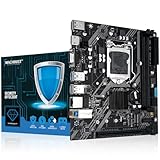
- Intel LGA 1155 Socket: The Intel B75 motherboard supports Intel 2nd and 3rd gen Core i3/i5/i7, Xeon E3-12xx, E3-12xx V2 series...
- Dual-channel DDR3 Slots: 2 DDR3 Non-ECC desktop memory slots, unbuffered, support effective frequencies of 1333/1600MHz, and a...
- High-definition Video Output: This gaming motherboard features VGA and HDMI-compatible display interfaces. As long as the...
- High-definition Video Output: This gaming motherboard features VGA and HDMI-compatible display interfaces. As long as the...
- The package Includes: 1*SATA cable, 1*I/O baffle, 1*motherboard. The motherboard does not include a battery. User manual is not...
- Intel LGA 1155 Socket: Supports Intel Core i3/i5/i7 2th or 3th generation processors, as well as Xeon E3 v2, Pentium and other...
- Dual-channel DDR3 Memory Slots: 2 DDR3 non-ECC desktop memory slots, unbuffered, support effective frequencies of...
- NVME/NGFF M.2 SSD Interface: This H61 gaming motherboard is equipped with a M.2 interface, which can be converted between NVME and...
- VGA and High Definition Multimedia Interface: It can support 1080P high-definition video output without a graphics card. Note: To...
- The package includes: 1*H61 motherboard, 1*SATA cable, 1*I/O baffle. User manual is not included in the package, you can download...
- Intel LGA 1155 Socket: The Intel B75 motherboard supports Intel 2nd and 3rd gen Core i3/i5/i7, Xeon E3-12xx, E3-12xx V2 series...
- Dual-channel DDR3 Slots: 2 DDR3 Non-ECC desktop memory slots, unbuffered, support effective frequencies of 1333/1600MHz, and a...
- High-definition Video Output: This gaming motherboard features VGA and HDMI-compatible display interfaces. As long as the...
- High-definition Video Output: This gaming motherboard features VGA and HDMI-compatible display interfaces. As long as the...
- The package Includes: 1*SATA cable, 1*I/O baffle, 1*motherboard. The motherboard does not include a battery. User manual is not...
Buying Guide – How To Choose the Best Motherboard
Available Formats
The dimensions of a motherboard represent one of the distinctive characteristics of this kind of product and are placed at the top of the selection criteria ranking. Several formats are available on the market, defined by as many standards.
To clarify a bit, we must necessarily refer to some acronyms and measures, a passage that may be a bit tedious but mandatory to better understand.
Among the most popular models, there are those with ATX and ITX standards. Two sizes characterize the former: average (305 x 244 mm) and micro (244 x 244 mm) while the latter, available with petite proportions, are identified by the abbreviations mini, nano, and pico. Read datasheets and reviews carefully to identify them better.
The decision regarding the dimensions of the motherboard is subject to the size of the case, which, of course, must be large enough to accommodate it.
In case you already have the PC body, carefully calculate the space, otherwise decide before which mainboard you prefer and buy a situation that can accommodate it without difficulty.
Closely related to the dimensions, and therefore placed at the top of the ranking of the aspects to be taken into account, there is the number of ports and slots integrated on the motherboard.
The larger models (and therefore ATX) offer a higher possibility of connections and expandability than the smaller ones.
The Processor
Another element to be carefully evaluated, because it is a distinctive feature that characterizes the various cards of the best brands, is the type of socket used, that is, which processor can be connected.
From this point of view, the choice is somewhat limited because only two companies produce them: Intel (with the LGA line) and AMD (with the AM and FM families).
Regardless of the type of socket, remember that this choice will also end up addressing the one on the processor: if, for example, you buy a motherboard with FM2 + socket, the CPU must also host the same standard.
Very important is the chipset, the element that has the task of sorting the information between the processor, RAM, hard disk, and all other parts of the computer. Comparing the prices of the various models, you will notice that this element is the one that most influences the cost of the mainboard.
Various Standards
To close the circle on what a motherboard has to offer, support for the most common standards available cannot be missing. Although you may be tempted by the affordable price of a not very recent model, our advice is still to spend a little more but buy a new generation model.
A self-respecting motherboard cannot ignore USB 3.1 to connect external peripherals, from PCI Express 3.0 to connect the video card, from Sata 3.0 or Sata Express for the hard disk and disks in SSD format.
Keep in mind that there are a good number of expansion slots, especially those that house the RAM banks, as well as support for wi-fi and Bluetooth wireless connections.
How to Use a Motherboard
When you decide to assemble a PC with your own hands, one of the components that can make the difference is the motherboard.
Here you will install CPU, Ram, and various cards, and the quality or otherwise of the motherboard can affect the overall performance of these components, and therefore on the performance of the newly assembled PC.
Atx or Micro Atx
To choose the right motherboard, you must first decide what type of pc you will assemble. If you want a small computer, then the choice will fall on a micro atx type motherboard, which has adequate dimensions to be housed in small cabinets.
These motherboards provide practically all the connections and integrated audio/video options. For this reason, they are chosen to assemble office pcs or multimedia systems to be placed alongside the home tv.
If instead, you opt for the classic desktop, the most logical choice will be an atx motherboard. In this case, you can make different types of upgrades always to have a device in step with the times.
Atx cards are very suitable for those who want to assemble a pc to play, with models specifically designed for this type of use.
Amd or Intel and Related Chipsets
Once You Have Chosen the Type of Pc to Be Assembled, You Will Need to Decide Which Processor to Bet On. The Cpu Market Is Divided Between Amd and Intel.
Based on Which Type of Cpu You Choose, and You Will Also Have to Think About the Motherboard that Integrates the Chipset and The Socket that Supports This Processor. Several Chipsets Support the Various Cp Us, and Therefore the Same Models of Motherboards on The Market Are Different.
Better to choose the latest generation chipset that is able, one day, to hold up even the new cp us, provided that the manufacturer does not change the socket or the type of connector where the processor is housed on the motherboard.
In most cases, the chipset also determines the video section available, with the chips of this component now present on most motherboards.
If you do not need high-level graphics performance, the video chip integrated into the motherboard, in most cases, is more than suitable for multimedia and office activities.
If, on the other hand, you want to play at the highest levels, you must be sure that the motherboard offers one (or two) PCI-express 3.0 connections where the external video card will be inserted.
Upgrade
When choosing the motherboard, the upgrade possibilities and the ports it makes available are essential. By now, most motherboards offer integrated audio, video, and lan, while newer models also have a wi-fi connection.
At the port level, there should be USB (better if 3.0) and sata where both the classic flat hard disks and the new ss ds will connect.
Also relevant is the provision of slots for a ram: better to opt for models with four slots that will guarantee a more straightforward upgrade of this component if the need is felt in the future.