A metal bench lathe is used to rotate the piece on which you need to work in order to perform continuous work on the entire surface. The operating mechanism of a machine is straightforward and is based on the rotation of the shaft, driven by a belt, which in turn is activated by a motor.
However, if on the one hand, the operation is the same for all types of lathes, on the other hand, there are, on the other hand, many differences between the various types of metal lathe and not all of them are adequate for the work and the purpose to be pursued.
Here we had listed out the best benchtop metal lathes for you that are present below.

- Security Comes First: Our metal lathe machine has multiple security features in case of emergency, ensuring operator security....
- Continuously Variable: Features a spindle that can turn in both forward and reverse directions, with two-speed options: a high...
- 750W Brushless Motor: Our benchtop metal lathe features a 750W brushless motor that provides more power and avoids the need for...
- Built to Last: Our power metal lathes are built to last with high-quality HT200 cast iron. They come equipped with wear-resistant...
- Widely Used: Our metal lathe machine, measuring 8.3'' x 29.5'', is perfect for processing precision parts and models. It has a...

- [Main Parameters]Length of center:39.37"(1000mm), Swing Over Bed:8.27"(210mm), Rotary diameter of tool rest:5.51"(140mm), Diameter...
- [1000mm Swing Range]The bench top lathe brings 3-jaw and 4-jaw chucks with Diameter: 4.92"/125mm.Range of metric...
- [Simple Operation] Three ways to start turning: manual start, automatic start, delay automatic start.Can switch the direction of...
- [Scale]Telescopic sets with scale, you can intuitively see the length of the telescopic handle scale, precise scaling can be...
- [Imperial/Metric Lathe&New Gearless Design]Switching between imperial and metric is no longer required by changeing gears.Only...

- Precise Engineering: Ideal for professionals, this power metal lathe's high-precision 4-inch 3-jaw chuck handles both square and...
- Large Working Capacity: This metal working lathe cranks out 550W and handles small to medium projects. It provides a 7.09"/180mm...
- Upgrade Design: This small metal lathe uses metal gear instead of a nylon one. Aluminum handwheel can increase service life....
- Complete Control: The lathe's rotational speed can be set from 50 to 2500rpm and monitored by the digital display; the...
- Professional Construction: 4-way quick change tool post can install 4 standard turning tools at the same time. You can adjust tool...
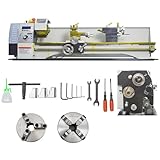
- [Imperial/Metric Lathe&New Gearless Design]Switching between imperial and metric is no longer required by changeing gears.Only...
- [Main Parameters]Length of center:31.50"(800mm), Swing Over Bed:8.27"(210mm), Rotary diameter of tool rest:5.51"(140mm), Diameter...
- [800mm Swing Range]The bench top lathe brings a 3-jaw Chuck with Diameter: 4.92"/125mm.Range of metric...
- [Simple Operation] Three ways to start turning: manual start, automatic start, delay automatic start.Can switch the direction of...
- [Scale]Telescopic sets with scale, you can intuitively see the length of the telescopic handle scale, precise scaling can be...

- Mini Yet Powerful: Measuring only 43.7x16.9 in., this mini metal lathe by Creworks packs a punch with its 1100W motor, making it...
- Complete Control: The mini metalworking machine's rotational speed can be set from 0 to 3000 rpm and monitored through the...
- Precise Engineering: Ideal for professionals, this benchtop mini metal lathe's high-precision 5 in. 3-jaw chuck handles both...
- Ultra Sturdy & Safe: The robust cast iron construction ensures a long service life and superior corrosion resistance. The...
- Wide Application: Tailored for precision tasks, this mini woodworking lathe effortlessly handles turning, drilling, threading, and...

- 7" x 14" Metal Lathe: Our metal lathe machine adopts external poly-V-belt drive technology. The output torque is increased by 3...
- 4-Speed Adjustment: The benchtop metal lathe adopts a 4-speed continuously variable function so that you can adjust spindle speed...
- High Accuracy & Professionalism: The tailstock spindle features an MT2 taper with top-press thread quick-lock technology for...
- Forward & Reverse Thread Turning: All gears of the power metal lathe are made of high-quality metal material, ensuring a longer...
- Security Comes First: The benchtop metal lathe has chuck cover disconnection protection, automatic overload protection, and an...


- Dual-Head Design with Double Chuck: Features two chucks on the left side with concentricity tolerance of 0.03-0.05mm.Processes...
- 1100W Brushless Motor with Variable Speed: Powered by a 1100W brushless motor offering two adjustable speed ranges of 50-1250 RPM...
- Two-Axis Digital Grating Ruler: Equipped with a digital display grating ruler achieving 0.005mm accuracy.Enables precise...
- Follower Rest and Steady Rest: Includes a follower rest for supporting slender workpieces and a steady rest for long...
- Adjustable 4-Way Tool Post: Allows quick changes of cutting tools with eight screws for better grip.Supports turning end...
Buyer Guide to Choose Benchtop Metal Lathes
What Is the Lathe and What Is It For?
Before understanding where to place your purchase, it is right to make a clarification concerning its function. A lathe is a tool that is used to polish, fillet, consume, finish, and rough a surface quickly and accurately. Depending on the tip, you can obtain different processes and operate on different materials.
How is such an object made, and what are the commands to be operated? Here is a clear definition that I took on the Wikipedia page with a series of useful points to understand what its structure is:
- Speed change
- Horizontal movement.
- Transverse sliding.
- Self-centering chuck.
- Tool holder element.
- Tool holder turret control.
- An element for the tailstock.
The bench version of the lathe allows you to work with high precision on wood, plastic, and metal. There are specific models for certain uses and solutions suitable for both home use can be purchased.
Without forgetting the semi-professional models. Of course, there are also industrial lathes or suitable for the workshops of artisans who need this tool for continuous work.
Do You Want Lathe for Metal or Wood?
We often hear about this possibility: use a lathe designed for iron or steel in different situations. For example, in woodworking. That’s a good idea? Not really, on the contrary: there are problems.
The risk of ruining the object is high, and the same applies to damage to things and people. The basic rule is this: always use the right tools for a particular purpose. Bench lathes are used for wood and those for metal, including specific models for steel that have particular characteristics.
How to Choose the Best Lathe?
The operation of this tool is quite simple. There is a motor that runs a shaft to which the vice is connected, which holds the object to be machined.
Then there is a point or the cutter that allows you to engrave and consume the block as needed, regularly and without abrupt movements, working on the removal of the chip. What are the parameters to be respected? How to choose the best benchtop lathe for your business?
Motor Type for Your Lathe
This is the first decision that must be made: the strength of the mechanism that allows you to obtain the rotary movement (continuous, regular, and weighted) will enable you to work or not on certain materials.
It can be quite logical the consideration that a powerful motor helps with complicated processes. Consequently, a benchtop lathe on 500 watts is a good starting point for having a valid product.
While considering that you can go over 2,000 watts for an active bench lathe, furthermore, one should not forget the type of engine to evaluate the reliability and continuity of the work.
A single-phase asynchronous engine is certainly less suitable for intense work, and it is inexpensive and ideal for home use. At the same time, a three-phase motor is ideal for professional use because we are talking about a more reliable and lasting solution.
Dimensions of The Bench Lathe
This choice is not just about the space required to find the area on your work surface. The dimensions of a bench lathe also concern its ability to work on certain surfaces and with specific objects.
This means that a machine offers a certain distance between the points and allows you to work with more or less abundant elements. Who works mainly with small objects can choose different lathes.
How to Choose the Best Bench Lathe?
They are tools ranging from 200 mm for metals and about 300 for wood, up to typical dimensions of industrial machines that exceed 1,000 mm. Also, the diameter, the height of the tip from the base, must be evaluated considering the size of the objects to be subjected to the various turning operations.
Weight and Robustness of This Tool
A quality lathe is designed to last. It must have a good weight, a steel structure, or equivalent material in terms of resistance and an ability to hook onto the counter with the maximum possible safety. It avoids any unstable solution, which saves money at the expense of robustness.
Number of Lathe Speeds
One of the features to be carefully evaluated when asking a professional how to choose the best bench lathe is the presence of a variator that allows giving more speed to this tool.
The idea of having to work with a limited number of possibilities when considering the rpm of the bench lathe is an option that should be far from the professional use of this tool.
For this reason, in addition to positively evaluating the purchase of a bench lathe with a good number of speeds, it is also useful to consider the presence of reversing the gear to improve sanding operations.
How to Choose the Best Lathe?
It is clear at this point that there is no real definition of what is the best choice. Many bench lathes can be useful in a personal workshop suitable for DIY and DIY enthusiasts.
Ultimately, the point to evaluate is the price. As always happens in these cases, you can not think of getting everything you need, with the highest possible quality, at minimum costs. Then?
A less complicated machine that suits your needs is better than focusing on solutions that promise a lot but do not respect quality standards such as the precision of the guides and the spindle.